Growth Spark Media

  • Home
  • Who We Are
  • What We Do
    • Overview of Our Services
    • Portfolio – Websites
    • Portfolio – Video Ads
  • Scan Your Business
  • Latest News
  • Contact Us

Promised #1 on Google? It Doesn’t Mean What You Think It Does

By

Many internet marketing companies state that their services can get you to “number one” on Google, but do you know what is actually being done to get you there? Search engines have changed and “number one” cannot be guaranteed. Here is what you should know:

1. Getting to “number one” on Google isn’t necessarily the best goal for local businesses.
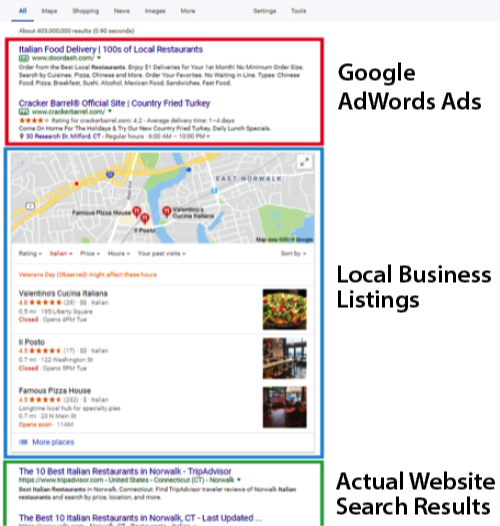
The first position on Search Engine Results Pages (SERPs) are paid ads. This is what is being offered to you when you hear the line “we can get you to number one on Google” (see example at right)

  • People who search for local businesses tend to ignore ads, and scroll to listings and search results.
  • Searchers know that ads may be from national companies with no local presence in the community.
  • Nearly all clicks on ads are accidental during searches for a local business.

2. No one can guarantee that you will be “number one” on Google.
Google doesn’t allow any website to be the “king of a keyword”; it’s about showing searchers what THEY want to see, based on their prior internet activity and location at the time of search:

  • Google changes its ranking algorithms¹ frequently, so what worked previously, might not work today.
  • If your business/website was previously visited, you are more likely to be number one, or high up on the page, if that person does a search relating to your business.
  • You might be number one for those who live around the block from you, and number five for those who live one town over. Your position is NOT static even if it looks that way when you search for
    your own business.

3. Google AdWords² is not Search Engine Optimization, so what is?
Search Engine Optimization (SEO) is about the content/structure of your website being tuned to peoples’ searches, not about placing ads leading to clicks to your website:

  • The hit on your website through AdWords is not making it more “in demand” in the eyes of the search engines because the click did not originate from your website’s link on the SERP.
  • Focus on actual SEO, so that the rankings you generate are real, with quality over quantity content that is relevant to who you want to drive to your website.
  • Come up with a specific goal, such as pushing a product, service or sale and keep track of results.

Local businesses should have a unique approach when it comes to SEO, based on industry, location, and other factors. Be wary of companies making promises before getting to know your goals. Being number one on Google is not necessarily the ticket to success anymore in today’s digital landscape.

¹Algorithms: how social media platforms filter, rank and organize the content we see based on a specific set of criteria (prosperforpurpose.com).

²Google AdWords: An advertising service by Google for businesses wanting to display ads on Google and its advertising network. Businesses only pay when people click on ads; the service is largely focused on keywords. (webopedia.com).

Filed Under: News

4 Ways to Give Your Business a Digital Tune-Up

By

All businesses are digital in some aspect.  Between finding new customers or staying connected to current ones, there’s much to consider for your marketing strategy.  Below are 4 key ways to give your business a digital tune-up:

1) Give your digital platforms a review.
Consider the look of your website, which is often your first impression to consumers:

  • Ensure that your website is clean, responsive and easy to navigate.
  • Fix broken links, refresh images, and update designs to engage more visitors.

2) Yes, you probably should pivot to video.
Research predicts that video will account for more than 80 percent of web traffic¹:

  • Video can often better engage and tell a story than can a whitepaper or blog post.
  • Video can be repurposed and shared across multiple platforms.

3) Think about your social media strategy.
Determine how social media plays a part in your overall business:

  • If it is a source for new customers, or if continued engagement is important, then focus more attention on social media.
  • Social media platforms each have their own strengths and weaknesses. If you have a loyal following or products/services that do well on a specific platform, stay the course.

4) Great content still matters.
Research indicates that longer-form, higher-quality content will be even more important in the years ahead²:

  • Avoid generic filler content that populates the page with useless language.
  • Provide readers with value so they feel they’ve learned something beneficial.

Leading trends in digital marketing will help move your business forward with a vision for success.  A balance between traditional marketing and an eye toward the future of brand building through digital is important in today’s media landscape.

Source:  BusinessNewsDaily.com, written by Derek Walter, founder of Walter Media; ¹Cisco Visual Networking Index-Forecast and Trends 2017-2022; ²Forbes-buzzsummo.com; internetmarketinginc.com

Filed Under: News

Business Growth: Top Marketing Priority

By

A recent study shows that CMOs (Chief Marketing Officers) rank business growth as the top priority in marketing goals. Following are insights into achieving this objective, as well as other strategies and challenges*.
What are the top priorities in marketing?

Business growth ranks first as the primary role of marketing:
• #1: Delivery of business growth.
• #2: Ensuring effective brand management.
• #3: Developing the overall customer experience.

How do CMOs support business growth?

Building lasting relationships with customers is key to delivering business growth:

• #1: Securing long-term customer relationships.
• #2: Driving revenue growth.
• #3: Enhancing margin growth.

CMOs see a battle for consumer attention.

There are challenges in building long-term customer relationships:
• #1: Increasing levels of competition.
• #2: Consumers’ less responsive to traditional advertising.
• #3: Information overload.

*Top 3 rankings for each category

Source: Dentsu Aegis CMO Survey Report, reported by Marketing Charts

Filed Under: News

What Are Connected Consumers Doing and Not Doing Online?

By

Online activity is a two way street:  consumers are “showrooming”— browsing businesses and going online, and “webrooming”— researching online and purchasing in brick-and-mortar establishments.  Following are insights about success in the connected commerce space.

What Consumers are Doing Online (activities scoring high):

  • Looking up product information.
  • Checking/comparing prices.
  • Searching for deals/promotions/coupons.

What Consumers are not Doing Online (activities scoring low):

  • Clicking on email ads.
  • Subscribing to product/store emails.
  • Liking/tweeting/commenting on social media.

Consumers Pursue Information All the Time (see chart):

  • 87% before visiting a business.
  • 79% while visiting a business.
  • 35% after visiting a business.

Strategies for Omni-Channel (Online/Offline) Success:

  • Be customer-centric: Understand consumers’ demographics, purchase habits, path to purchase.
  • Prioritize personalization: Provide clients with relevant, personalized information/offers.
  • Think digital, but don’t neglect in-store: Physical establishments maintain many key advantages over online-only channels.  Customer service is a differentiator in every channel — providing exceptional service should be a primary focus for businesses.

Connected consumers = smart consumers, and they are using digital options to make informed purchase decisions, from reviewing products/services online to using in business establishments.

“Digital is viewed less as a threat to brick-and-mortar… and more as an opportunity.  Today’s winning brands use a combination of on and offline strategies to… help consumers make more informed decisions… [and] add value throughout the entire [purchase] experience.”

— Patrick Dodd, President, Nielsen Global Retailer Vertical


Source:  thinkwithgoogle.com


Filed Under: News

The New Role of Marketing

By

A Customer Experience strategy achieves higher customer satisfaction/retention, a positive impact on customer loyalty and increased revenue.

Marketing is always changing, and Customer Experience (CX) – interactions between a business and a customer throughout their relationship (ex., awareness, discovery, cultivation, advocacy, service, purchases) – is the new marketing battlefront, focusing on making businesses people-friendly.

  • 89% of businesses expect to compete mostly on the basis of CX.¹
  • 74% believe that CX impacts customer loyalty.²

Following are tips to help build Customer Experience through marketing:

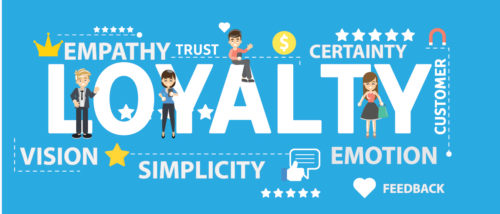
1. Emotion
Create emotional connections: emotionally-engaged customers are at least three times more likely to recommend your product/service, three times more likely to re-purchase, and less likely to shop around (44% said they rarely or never shop around).³

2. Empathy
Put yourself in the shoes of people who use your product/service; connect and empathize with any situations that are facing your customers.

3. Certainty
Spend enough time identifying and aligning any problems; use solutions that will create the most people-friendly outcome.

4. Simplicity
Don’t overcomplicate — simplicity wins with focus geared towards key principles.

5. Vision
Create a clear customer-focused vision, with guiding principles that will drive the behavior of your organization, and communicate this to your team.

6. Feedback
Capture customer feedback in real time with post-interaction surveys, using a variety of automated tools through emails and calls.

Customer Experience needs constant nurturing, and businesses who implement a CX strategy achieve higher customer satisfaction/retention, a positive impact on customer loyalty and increased revenue.


¹Gartner Study; ²Oracle; ³The New Science of Customer Emotions by Harvard Business Review
Source: The Marketing Insider, reported by Joe Parrish; SuperOffice, reported by Steven MacDonald

Filed Under: News

Can Brand Awareness Generate Measurable ROO and ROI?

By

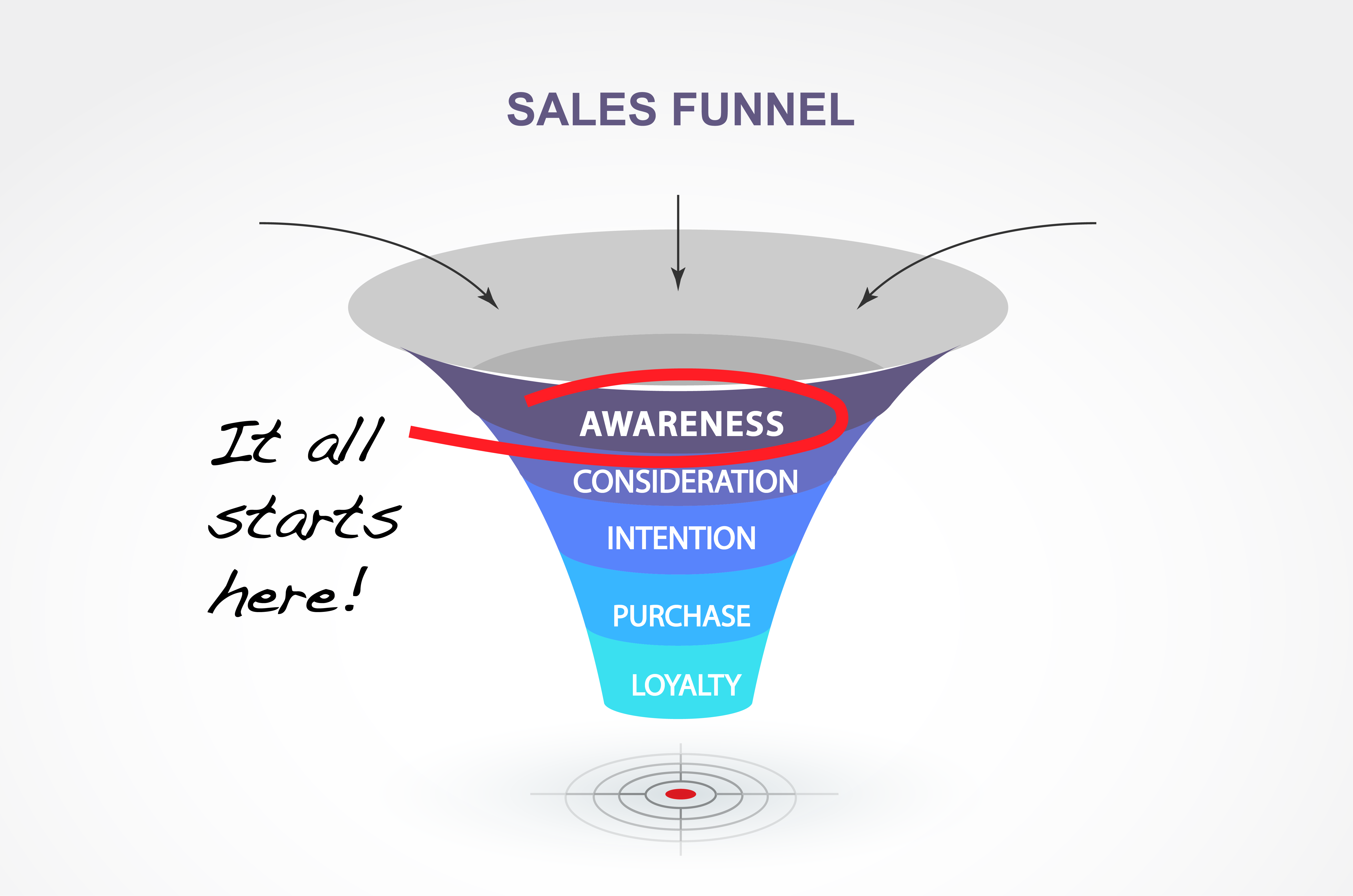
Awareness is the first stage in the customer purchase funnel — a buyer must be aware of your product/service before making a purchase. While ROI (Return on Investment) focuses on sales, ROO (Return on Objectives) focuses on defining metrics, such as increased awareness, brand impact, and purchase intent. Awareness is an important metric to be measured as it can be a major asset when trying to influence purchase decisions.

STRATEGIES

Brand awareness is part of the collective marketing effort necessary to drive incremental sales. Measurements must ultimately align awareness impact with the influence on conversion rates and customer value in order to show ROO and ROI. ROO defines long-term objectives; ROI is a short-term measurement. Taken together, ROO and ROI provide a complete picture.

Strategies for how awareness contributes to driving objectives and sales defines the metrics used to measure effectiveness:

  • For short-term gain, generate a spike in awareness just prior to an integrated campaign; also, condition the target audience with awareness of key attributes that educates potential buyers.
  • For long-term strategy, re-position brand perceptions that builds awareness of advantages relative to a competitor, leading to higher preference, sales conversion, and loyalty.

METRICS
Awareness works well as a “diagnostic” tool to understand why other metrics, such as consideration, intention, purchase, etc., may be under-performing:

  • Place increased weight on your primary target audience since they are a good fit with your brand and are more likely to move from awareness to consideration and purchase.
  • Assess awareness among buyers currently in the purchase funnel, which is a better measure of effectiveness than from consumers not likely to buy for a long period of time.

MEASUREMENT
To measure ROO and ROI from awareness-building initiatives, design the measurement to understand customer behaviors:

  • Assess the short-term lift in engagement and purchase actions associated with increases in brand awareness; allow for a slight lag time using modeling or market testing.
  • Track perception metrics and your brand attribute ratings relative to competitors with ongoing or pre-post campaign surveys; closely monitor awareness changes relative to other metrics (consideration, intent, purchase, etc.).

Filed Under: News

The Importance of Business Listings

By

Your business is mentioned all over the Internet.  It’s important to have your business listed in as many directories as possible, as it helps your ranking in Google Maps’ search results and with local SEO (Search Engine Optimization).  Following are steps for optimum results:

1. Consistent NAP (Name, Address, Phone Number)

  • Google improves search results by aggregating information about your business from all over the web. Make sure your name, address and phone number are listed the same everywhere, especially if your business has moved, changed names or phone numbers.
  • Check that your business information on third-party sites is accurate; contact the respective site directly with any corrections.

2. Google Yourself

  • Google your business to see if it shows up in directories, such as Yellow Pages, Manta, Yelp, Foursquare, etc.
  • Every directory gives the option to update information. Follow up in two weeks to verify any changes you made.

3. Take Ownership

  • Many directories add businesses on their own, not based on submissions.

  • It is important to see if there is an option to claim, manage or take ownership of your listing.

4. Document

  • Taking ownership gives you full control over your listings and is essential in keeping your information correct.
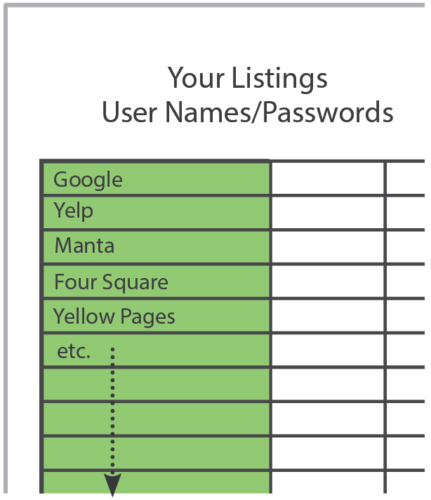
  • Document the sign-in user name/password for each listing, so if your information needs changes, you can easily do it yourself.

Listings are the first “picture” consumers will see of your business, so ensure that each one is accurate, informative and up to date.  Claiming and maintaining listings is one of the most crucial elements of your presence on the Internet. 

Source:  Jordan J. Caron, Meaningful Marketing; Google My Business Support Area


Filed Under: News

What Consumers Want From Brand Content

By


While consumers are cautious in their viewing and sharing of information, brands can influence purchase activity with their content efforts. Following are insights from a recent study:


1. Why Brand Content is Valuable: Information; Differentiation

  • Consumers prefer content that provides information, not promotions.
  • Content helps consumers choose between products/services and helps them make a final decision.
  • Informative content is valuable to consumers even after they’ve made their purchase.

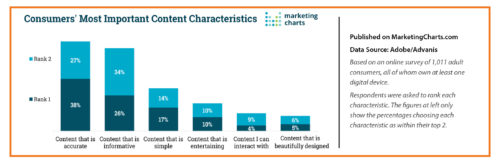
2. So What is Good Content? It’s Accurate and Informative (chart below)

  • Accuracy in content is most important: 38% rank it number one; 65% place it in their top two.
  • Informative content runs a close second: 26% rank it number one; 60% place it in their top two.
  • Simplicity is third in importance: 31% rank it in the top two; 60% place it in the top half.

3. Consumers Prefer Content That is Precise, Relevant, Fresh

  • Consumers prefer content that is both precise and adequately written.
  • Nearly 70% of consumers say relevant content is important when learning about a product/service.
  • Two-thirds of consumers tend to make a purchase if content is fresh, includes video/images and is optimized.

4. Content That is Cause-Related/Informative/Valuable is Shared and Triggers Purchases

  • 35% shared content that raised awareness for a good cause.
  • 34% shared content that was informative, not promotional.
  • 57% made a purchase as a result of valuable online content.

Content is invaluable as it is an integral part of a consumer’s purchasing decision.

Source: Adobe / Advanis, reported by MarketingCharts.com

Filed Under: News

The Age of Local: The New Marketing

By

In the past, companies typically used mass media (ex: TV, print, radio, etc.) to reach large audiences and there was limited data for digital advertising.
Today, we are in the “age of local,” where marketing wars are digital and local relevance is key for major brands and local businesses.

Follow the Money

  • Multi-location brands are spending 25% of their budgets on location-based marketing.
  • More than 50% of multi-location brands are using location data to target customers.1

New Balance of Power

  • Local businesses are investing in digital, going head-to-head with the national competition.
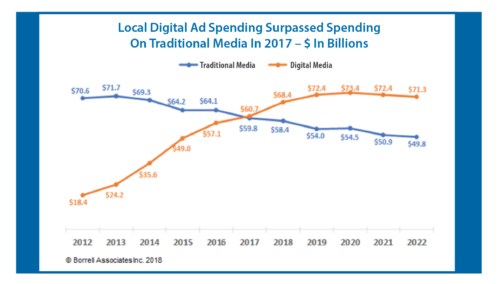
  • Digital ad spend overall surpassed that spent on community-based print and broadcast for the first time in 2017, and this trend is forecast to continue through 20222 (see chart):

Getting to Digital Proficiency

Location is a critical element of digital marketing. Determining the best investments for local coverage is expected to be an increasingly important part of a marketing plan.


Studies:
1LBMA (Location-Based Marketing Association) Global Location Trends Report;
2Borrell Associates
Source:
MediaPost-The Marketing Insider, reported by Lynn Tornabene; LSA (Local Search Association) Insider, reported by Joe Morsello

Filed Under: News

ROO:  Digital Out-of-Home’s New Success Metric

By

Marketing is the first step in the sales process. Sales conversions typically now take more time, making Return On Objective (ROO) a more realistic standard on which to weigh your efforts versus the common form of using Return On Investment (ROI).


Return On Objective (ROO): a flexible approach based on a specific set of objectives.
Return On Investment (ROI): measures sales made before and after an investment.


ROO versus ROI:

  • ROO is a better measurement, as it relates to defining long-term objectives – increasing top-of-mind awareness, establishing expertise/reputation, strengthening customer loyalty, building market share, etc. – and then tracking results.
  • ROI is a short-term measurement concept, as it correlates directly to a monetary value – using sales promotions, turning over inventory, tracking sales/returns frequency, etc. – and doesn’t monitor customer loyalty or how it is taking longer for consumers to travel through the sales funnel.
  • Buying behaviors continue to change and the market is growing more complex as new channels and technologies emerge.

Benefits of ROO:

  • ROO is objective rather than sales based, so you can target any goal and adapt accordingly.
  • ROO enables teams to prove campaign impact when it’s not feasible to tie them directly to sales.
  • ROO encourages you to take a look at the effectiveness of your marketing methods, so you’ll know what’s working, even if sales don’t spike instantly.

Measuring Results with ROO:

  • Improved business and customer awareness.
  • Increased market share.
  • Better engagement with online channels and social media.

Emphasizing ROO measurement is integral in achieving long-term marketing success. Implementing programs with objectives helps take customers through the purchase decision – the ultimate goal.

Source:  Business2Community, reported by Joshua Breyfogle; ScreenCloud; AudienceMetrix;
Empower MediaMarketing; firstagency.com; Henry Wurst Incorporated, reported by Joe Contrino


Filed Under: News

  • « Previous Page
  • 1
  • …
  • 3
  • 4
  • 5
  • 6
  • 7
  • 8
  • Next Page »

Our Location

located down the street from historic “SoNo” in Norwalk, we’re in the Shore Pointe Building.

1 Selleck St, 3rd Floor, Norwalk, CT 06855

See How GSM Can Help You

Use our free scan tool to see what your web presence looks like – you might be surprised what you find! Or, if you’re ready to get started with us, let us know!

Connect With Us

Want to keep up with everything we’re up to? Connect with us across our social media networks.

  • Email
  • Facebook
  • LinkedIn
  • Phone
  • YouTube

Copyright © 2026 · Custom Theme designed by Growth Spark Media